What costs go into a pool price?
Start with what the job costs you, line by line, before any profit.
- Materials: steel and shotcrete or the shell, plumbing, equipment, tile, coping and deck.
- Labor and subcontractors: excavation, plumbing, electrical, finish and deck crews.
- Site costs: access, haul-off, temporary fencing and restoration.
- Permit, inspection, engineering and survey fees, where your price includes them.
- Job overhead: supervision time, equipment rental and a warranty reserve.
What is the difference between markup and margin?
Markup is profit as a share of cost, and margin is profit as a share of the selling price. To reach a target margin, divide the cost by one minus the margin. A job that costs $50,000 sells for $50,000 ÷ 0.70 = $71,429 at a 30% margin. A 30% markup on the same cost gives $65,000, which is only a 23% margin.
- 20% markup is a 16.7% margin.
- 25% markup is a 20% margin.
- 33.3% markup is a 25% margin.
- 50% markup is a 33.3% margin.
- 100% markup is a 50% margin.
How do you cover overhead in a pool price?
Overhead is what the company costs to run whether a pool gets built or not: the office, vehicles, insurance, software, marketing and your own salary. A simple method divides a year's overhead by the pools you expect to build. $240,000 of overhead over 24 pools is $10,000 a pool, and it goes into the cost before you add margin. Build fewer pools than planned and each one has to carry more.
Should you price a pool per square foot?
Square-foot rates suit lines that grow with area, such as decking, and linear-foot rates suit coping and fence. They don't suit the whole pool, because a small pool needs the same equipment, permit and crew set-up as a large one. Price the pool as a package and the area-driven extras by measurement.
How do good, better and best options help?
Two or three priced options let the homeowner choose a level instead of answering yes or no to one number. Make each step up add something they can see, such as a spa, lights, a larger deck or a better finish, and keep the first option complete on its own. In PoolQuote, catalogue packages carry a good, better or best tier, and one proposal holds up to five options, A to E, each with its own pictures and total.
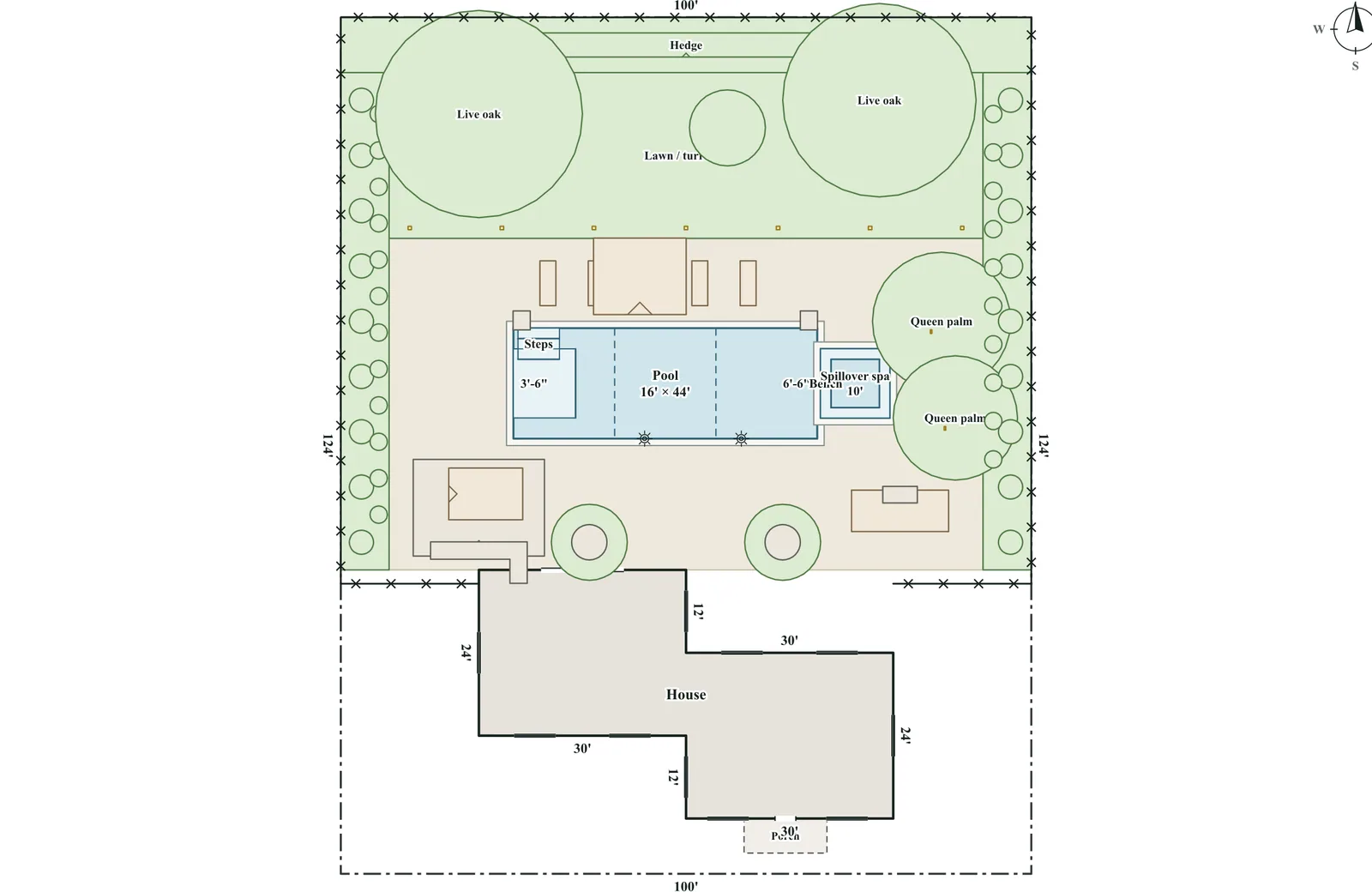
Worked example: a 16 by 32 pool at a 30% margin
Sample Pool Company and its numbers are fictional. They show the arithmetic only.
- Pool, equipment, plumbing and finish: $28,500 in direct costs.
- Deck and coping: $6,200.
- Site work, permit and haul-off: $3,300.
- Overhead share: $10,000, so the cost to cover is $48,000.
- Price at a 30% margin: $48,000 ÷ 0.70 = $68,571, leaving $20,571 of profit.
- Option B adds a raised spa that costs $10,150 installed. At the same margin it sells for $10,150 ÷ 0.70 = $14,500.
How do you check the price before it goes out?
Read every line against the plan: quantities measured, rates current, allowances explained and exclusions written. Then compare the total with recent jobs of the same size, because a price far below them usually means a missing line. PoolQuote won't publish an option while a catalogue item has no price, and Adjust prices moves every rate on an option together, 5% a step, up to 20% up or down, when you want to test another level.
Price your next pool in PoolQuote
Select Get started to choose a plan, add your catalogue rates once and price the next job from a measured plan. The pool estimate template works on paper, the pricing page lists current plans, or you can book a demo.